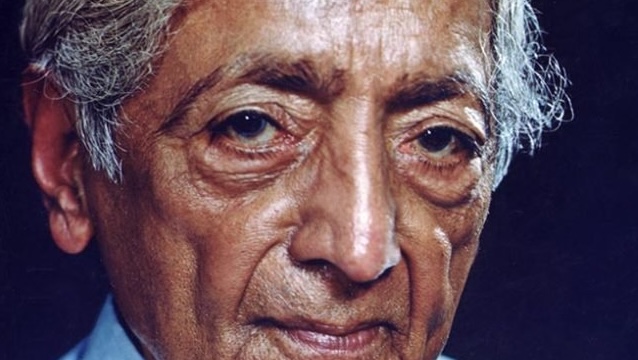
Krishnamurti on rejection of Organized Systems
Jiddu Krishnamurti’s teachings offer a profound and uncompromising vision of human freedom and transformation. Often described not as a fixed “doctrine” but as an invitation to radical self-inquiry, his core message revolves around the discovery of truth as a pathless land—one that cannot be reached through any organized religion, guru, ideology, or external authority. He urged individuals to question every form of conditioning—cultural, social, religious, and psychological—and to observe the mind without judgment or division.
At the heart of Krishnamurti’s teachings lies choiceless awareness: a state of pure observation where the observer and the observed dissolve into a single, undivided perception. This awareness naturally ends the illusion of the separate “self” or ego, which he saw as rooted in memory, fear, desire, and societal imprinting. When this psychological division ceases, conflict, sorrow, and fragmentation give way to love, intelligence, and true virtue. Meditation, in his view, is not a technique or practice but the very quality of total, attentive living. True religious life emerges from this freedom—not from rituals, beliefs, or dogmas.
Yet Krishnamurti’s message carries an intense sense of urgency. He repeatedly emphasized that humanity faces a crisis—not merely political, economic, or environmental, but a deeper crisis in consciousness itself. The world is in chaos: wars, division, exploitation, environmental destruction, and widespread suffering. Reforms, revolutions, and ideologies have repeatedly failed to bring lasting peace because they address symptoms rather than the root cause.
Krishnamurti insisted that society is the projection of the individual. As he stated, “The world is not something separate from you and me; the world is the projection of ourselves.” What we are inwardly—our greed, envy, fear, ambition, nationalism, and divisions—manifests outwardly as the structure of society. Society mirrors our collective psychological state: “What we are, society is. Society is not different from us.” If we are in conflict and fragmented within, we create a world of conflict and fragmentation.
This leads to his radical view on change: true transformation must begin inwardly, with a psychological revolution in the individual. Attempting to overhaul societal structures—through politics, economics, laws, or collective movements—without first addressing inner chaos only perpetuates more division and violence. External reforms are superficial; they may rearrange the furniture but leave the house rotten. Krishnamurti rejected gradual evolution or piecemeal improvement as illusions. “Reform needs further reform,” he observed, describing an endless cycle. Real change is immediate, total, and present—not a process over time.
He challenged the notion of working directly on “the structure of society” as the primary focus. Instead, one must destroy the psychological structure of society within oneself—the ambition, conformity, fear, and self-centered activity that sustain the outer disorder. This inner negation and freedom bring about a “total revolution” that naturally reshapes relationships and, by extension, the world. As he put it, “You can only be spiritual when you destroy the social structure of your being, which is the world in which you live—the world of ambition, greed, envy, and seeking power.”
The urgency stems from the present crisis: humanity cannot afford delay. The brain has evolved biologically over tens of thousands of years, yet psychologically we remain trapped in the same patterns of division and conflict. Without a fundamental mutation in consciousness now, the momentum of destruction accelerates. Krishnamurti asked: Is it possible for the conditioned mind to undergo this radical change—not through effort, method, or authority, but through direct insight and understanding?
In essence, Krishnamurti’s view flips conventional approaches. Societal change is not the goal we pursue through activism or reform; it is the inevitable outcome of personal liberation. When enough individuals awaken to this inner freedom, a different kind of society—one rooted in intelligence, compassion, and harmony—emerges organically. Until then, tinkering with the outer world is like prisoners improving conditions inside the prison walls without ever breaking free.
His teachings remain a timeless call: Look within, question everything, observe without motive—and in that choiceless seeing, the urgent transformation begins.
Here you can learn about Krishnamurti’s speech represented by Krishnamurti Foundation: https://kfoundation.org/urgency-of-change-podcast-episode-286-krishnamurti-on-the-structure-of-society/